July 11, 2026 · Admin
AI in Finance from Automation into Agentic AI
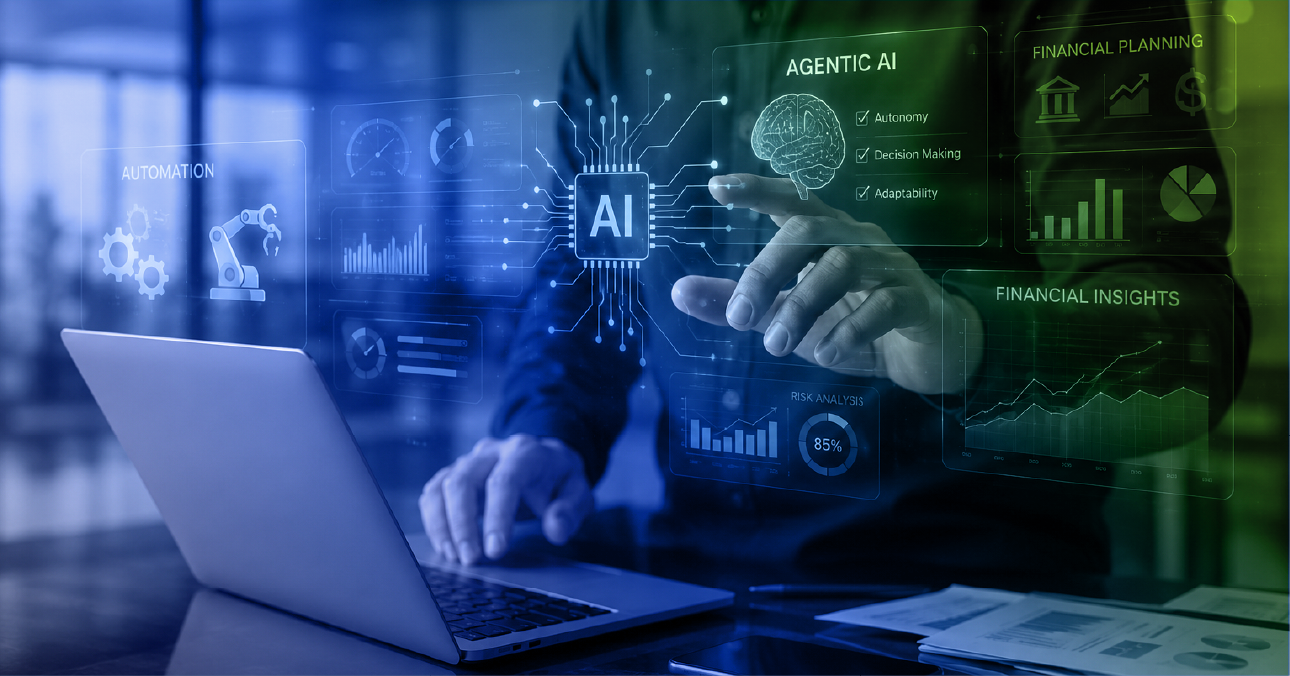
The Evolution of AI in Finance: From Automation to Agentic AI
For decades, finance ran on the same basic loop: collect documents, key in numbers, reconcile, review, repeat. It was slow and repetitive, but predictable. That loop is finally breaking apart. Artificial intelligence has moved from a buzzword in finance conference keynotes to a working layer inside the tools finance teams touch every day — general ledgers, accounts payable inboxes, forecasting models, audit software, even the chat window where a controller asks a question about last month's variance.
The latest and most consequential shift is the move toward agentic AI — systems that don't just answer a question but actually plan and carry out multi-step work on their own. Understanding how we got here, and what agentic AI actually changes, is the key to seeing where finance is headed next.
How AI in Finance Has Evolved
Stage 1: Rules-based automation. The earliest wave wasn't really "intelligent" — it was robotic process automation (RPA), scripts that clicked through the same steps a human would, following rigid if-then rules. Useful for repetitive, unchanging tasks, but brittle the moment a format changed.
Stage 2: Machine learning and pattern recognition. Next came systems that learned from historical data rather than following fixed rules — categorizing transactions based on patterns in thousands of prior entries, flagging a transaction as unusual because it didn't resemble anything the model had seen before, or improving invoice-matching accuracy over time.
Stage 3: Natural language and document understanding. Optical character recognition (OCR) combined with natural language processing (NLP) meant software could finally read a messy PDF invoice, a scanned receipt, or a long contract and pull out the meaningful fields — vendor, amount, due date, payment terms — without a human retyping any of it.
Stage 4: Generative AI. Large language models arrived and could draft financial commentary, explain a variance in plain English, summarize a lengthy filing, or answer a client's question — but still largely one prompt, one answer at a time, with a human directing every step.
Stage 5: Agentic AI. The current frontier, and the biggest structural change yet. Instead of waiting for a person to ask one question after another, an agentic system can take a goal — "close the books for this entity" or "process this batch of invoices" — break it into steps, decide which tools or data sources it needs, execute the work, and hand back a finished output for human review, only stopping to ask when it hits a genuine judgment call.
Each stage didn't replace the last — most finance teams today are running several of these layers at once, often without fully realizing it.
Where AI Is Being Used Across Finance Today
Accounts payable and invoice processing. AI reads invoices, extracts line items, matches them against purchase orders, and routes exceptions to a human — work that used to be pure manual data entry. High-volume, high-ROI, because the documents are repetitive and the rules are relatively stable.
Reconciliation and month-end close. Close-management platforms auto-match transactions, draft variance ("flux") commentary, and surface accounts that look statistically off compared to prior periods, compressing close cycles that used to take a week or more into days.
Fraud and anomaly detection. Rather than sampling a handful of transactions, some risk-detection platforms score effectively every transaction in a period against historical patterns and peer benchmarks, surfacing the small number that genuinely warrant a closer look — something manual sampling structurally can't do.
Revenue recognition and compliance. AI tools read signed contracts and map pricing terms, performance obligations, and modification clauses to standards like ASC 606, generating revenue schedules automatically instead of by hand in a spreadsheet. Similar tools handle sales-tax nexus tracking and filing.
Forecasting and FP&A. Predictive models built on historical financials support cash-flow forecasting, scenario planning, and budget-variance analysis, letting teams model "what if" scenarios in minutes rather than days.
Fraud, credit, and market analytics. Beyond internal bookkeeping, AI is widely used for bankruptcy prediction, credit risk scoring, stock-price and market forecasting, portfolio optimization, and anti-money-laundering (AML) monitoring — areas where pattern detection across huge datasets plays to AI's strengths.
Client and employee-facing chatbots. AI assistants embedded in finance platforms answer routine questions — when an invoice is due, what a client's tax deadline is — and escalate anything complex to a human, with a summary of the conversation attached.
General-purpose AI for drafting and research. Large language models are increasingly used for board memos, technical research on accounting and finance standards, and explaining complex provisions in plain language.
The common thread across all of these: AI is best at eliminating repetitive, high-volume, pattern-based tasks — freeing people for the judgment calls that define the profession.
Agentic AI: The Shift From Answering to Doing
Generative AI made it easier to ask a question and get a good answer. Agentic AI changes what "a task" even means, because the system doesn't wait to be asked one question at a time — it works toward an outcome.
In practice, an agentic finance workflow looks something like this:
Goal-setting. A person defines the objective — "prepare the flux analysis for this close" or "process this month's vendor invoices."
Planning. The system breaks that goal into sub-steps: pull the relevant data, identify which accounts need explanation, decide what supporting documents are needed.
Tool selection and execution. The agent pulls data from the ERP, cross-references it against source documents, drafts journal entries or commentary, and flags anything that doesn't fit expected patterns.
Assembly and handoff. Instead of returning a single answer, it delivers a structured, close-to-final output — a draft close package, a reconciled ledger, a set of coded invoices — ready for human review rather than a stack of open questions.
What makes this different from earlier automation is that agentic systems can chain many of these steps together without a person directing each one, and they can adapt the plan mid-task if something unexpected comes up — a missing document, an unusual contract clause, a transaction that doesn't match any known pattern. Earlier RPA-style automation could only follow the script; agentic AI can revise the script as it goes, within the boundaries it's been given.
This is already showing up in real workflows: agents that plan and execute an entire month-end close sequence, agents that read a batch of contracts and independently produce revenue-recognition schedules, and agents that manage a full accounts-payable cycle from invoice receipt to payment approval, only escalating the exceptions a human genuinely needs to weigh in on.
The tradeoff is that more autonomy raises the stakes of oversight. A single wrong assumption early in an agent's plan can cascade through every step that follows it, which is why the more credible agentic tools are built to keep every output transparent, editable, and traceable back to its source — so a person can verify the reasoning, not just the final number, before anything posts or gets reported externally.
Where This Leaves Finance Professionals
The realistic picture emerging across the profession isn't AI replacing finance roles — it's AI absorbing the repetitive, high-volume, pattern-based work, while people spend more time on judgment: interpreting a novel transaction, advising through a restructuring, or deciding whether an agent's output is actually right before it goes out the door. That shift raises the bar rather than lowering it, because reviewing and governing an agentic system well requires understanding both the finance and the reasoning the AI used to get there.
Agentic AI is the clearest sign yet that finance is moving from AI as a faster calculator to AI as a working member of the team — one that can plan, execute, and hand off real work, with humans setting the direction and making the calls that still require judgment, accountability, and trust.